Welcome to the Internet home of Building Contractors, LLC Water-proofing your home |
"Over 30 years of experience with all your home's needs" |
| Welcome to the Internet home of Building Contractors, LLC Water-proofing your home |
"Over 30 years of experience with all your home's needs" |
| There are many ways to water proof you home! | |
While it would be nice if we could just tell you here and now what we are going to do to solve your water problems, the first step really is to evaluate your home. |
|
| We evaluate your unique situation | |
Factors that determine the proper way to waterproof your home and basement include your basement wall constuction and condition, the condition of the slab or subfloor, the exterior grading, and the condition and layout of your gutters. These factors can affect the way that water threatens your home and basement. We may also take different approaches based on the condition of your basement (finished or unfinished), the age of the home and materials your foundation was built with, as well as factors outside the house, like large and established trees or landscaping. With that in mind, here are a few of the more typical ways to correct problems. After an evaluating your home, it may be that one or more of these items will best suit your needs. |
|
| We can add a "French Drain" in your basement floor. | |
For many people, the simplest method of diverting water that is heading for your basement is a "French Drain." Some houses were built with these, but if yours wasn't, it can be retrofitted into most situations. 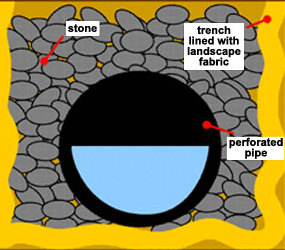 What a "French Drain" does is give
the water a place to go, channeling away
from your basement and into a pipe. This
pipe then feeds into a well (via gravity)
where a sump pump will pump it away from
the house. What a "French Drain" does is give
the water a place to go, channeling away
from your basement and into a pipe. This
pipe then feeds into a well (via gravity)
where a sump pump will pump it away from
the house. The picture to the right shows a cut-a-way view. To install a "French Drain" system, we need to cut into the basement floor. While this may sound intimidating to many people, we do it all the time and you don't need to worry. We will cut around the edge of the basement floor at the outside walls. This is where the water gets in as it flows down the basement walls (by means of gravity). (Water looks for the path of least resistance, which is you open basement if it can find a way there!) Once the concrete is cut away, we will dig out the dirt beneath it and install a perforated PVC pipe. This pipe has holes in it that allow the water to enter, but will still carry water flow to the other end. This pipe is laid on and covered with crushed stone. The stone allows the water to fill in around it and the "path of least resistance" becomes into the pipe. 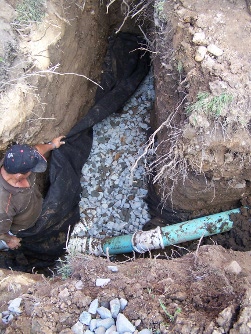 The pipe will surround the basement floor and meet a well that we will also dig out and install. As the water from the pipe (at about 6 to 12 inches below the basement floor level) exits, it fills the well that is several feet deep. When the water depth reaches a preset level (or fullness), a sump pump will turn on and the water is pumped up and out of the house and away from the foundation. This means that the ground water around your home is diverted before rising to the level of the basement floor. Once the system is installed, we will refinish the concrete floor of the basement. In most cases, this is the best way to deal with a problem in an unfinished basement. If the basement is finished, there are other approaches that may be suitable. |
|
| We can use an exterior method to water proof your home | |
The approach above collects ground water at the foot of the basement wall, but on the inside of the wall. We can also implement this outside of the basement wall. A lot more dirt needs to be moved, but sometimes it's a better solution. 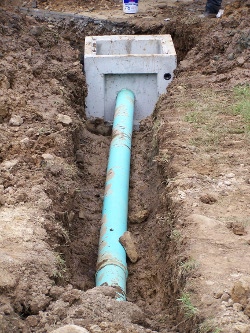 In this approach, we dig out around the outside of your home all the way to the bottom of the basement wall. This will generally involved some heavy digging equipment. Once we are down at the bottom level, we install the perforated pipe and crushed stone as described above. From here, we need a way to collect the water. In some cases, we can still use a sump pump, which will now be outside the house. In other cases, we may use a buried container called a dry-well (similar to what is shown at right). A dry well is typically a concrete or polyethylene holding tank. It also has holes in it (covered with a screen). This tank (which could be 100 gallons or more) fills and holds the water till it can be naturally absorbed by the surrounding soil. Some situations may require more than one dryable. (This is very similar to the way a septic system works, except instead of waste, it's the water that is leached back into the soil. After this is installed, the basement wall may also be insulated and/or coated with a protective finished to further protect it from water, and then the dirt is backfilled. With this kind of corrective work, we may not have to do all the walls of your house. It would depend on the layout and grade of the property. |
|
|
We can Dehumidify your Basement |
|
Basements are naturally a little damp - it's a consequence of being below ground level and having limited air flow. After a system has been implemented that repels water from the basement, you may want to consider a de-humidification system that will keep the air dry. This helps prevent musty odors, mold, mildew, dampness and other humidity-related conditions that can be damaging to your home, your health and anything you might keep or store in the basement. This is all but a must if you have finished off you basement into living space. |
|
| We have other resources to fight water with, as well | |
While the system described above will solve many water problems today's home owners face, we have other tools to fight water with, as well. 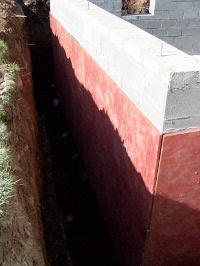 If we do an exterior French Drain, we can also clean and prep the exterior wall for a new water proof coating (with or without insulation - this is shown being installed on a new foundation, to the left). Many homes have settled with age. This can cause cracks in the foundation with provide a path for water. These can be repaired at this time, as well. On the inside, we can also acid wash the walls and coat them with a water proof paint, similar to what you may see on an in-ground pool. This helps prevent moisture that may accumulate inside the block wall from "effervescing" through the wall. On the outside, we can address some drainage problems by correcting gutters and downspouts. If the rain water the gutters channel off the roof collects at a low point against the foundation, the dirt there will get saturated and water will collect against the basement wall. By correctly directing the gutter water away from this area, we can limit the water that collects in trouble areas. |
| Call us today for a FREE ESTIMATE |